
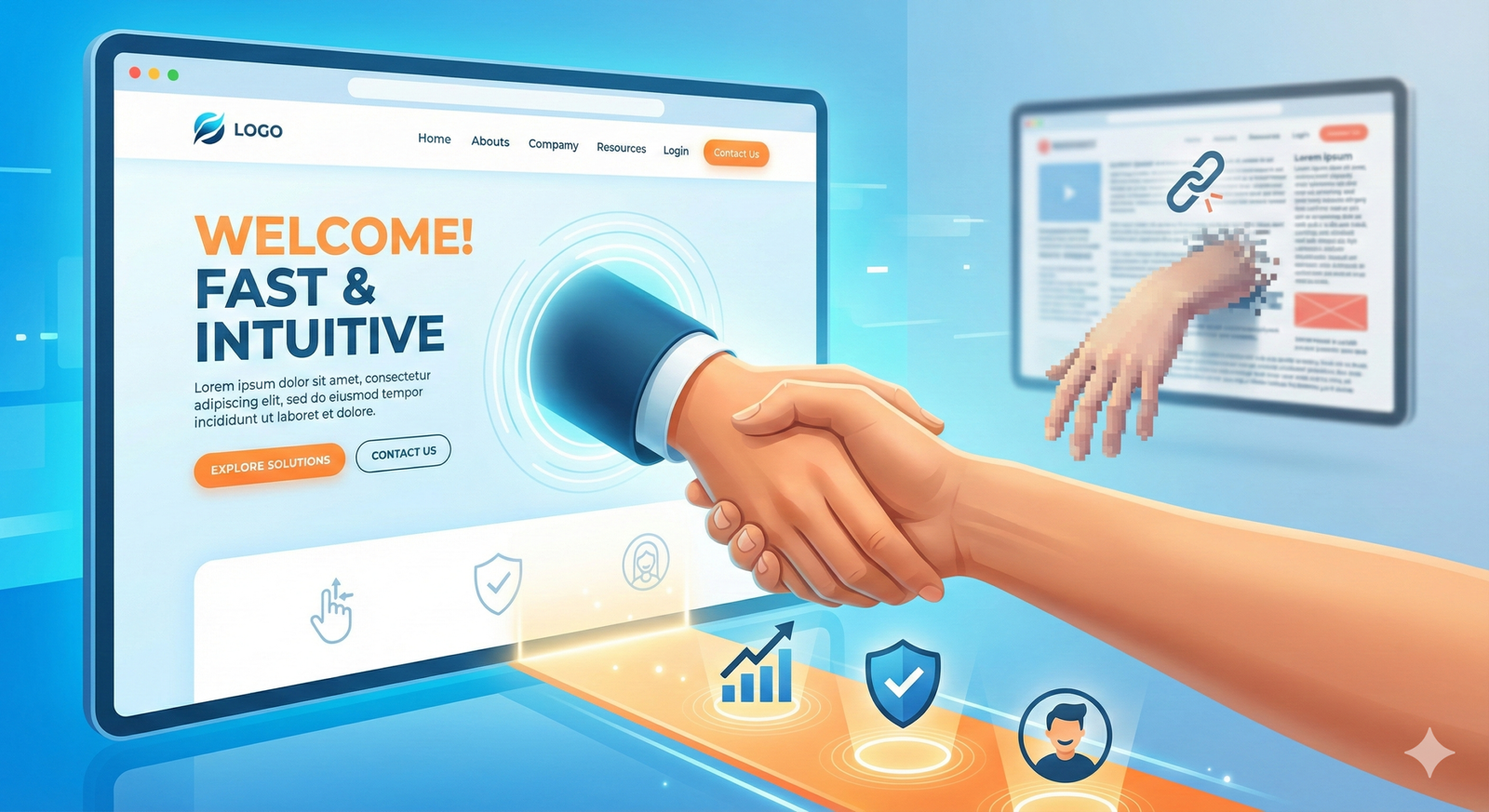
Your website is often the first handshake with a potential customer. Is yours firm and professional, or limp and confusing? Here is why an intuitive digital experience is your most powerful sales tool.
Imagine walking into a physical storefront. The lighting is dim, the aisles are cluttered, you can’t find a staff member to help you, and the checkout counter is hidden behind a stack of boxes.
What do you do? You walk out.
In the digital world, this scenario plays out thousands of times a day, but much faster.
According to research, it takes about 0.05 seconds (50 milliseconds) for a user to form an opinion about your website. That is a literal blink of an eye. In that microscopic window of time, they decide whether they like your site, whether they trust your business, and, crucially, whether they will stay or bounce to a competitor.
A website is no longer just a "digital brochure." It is your 24/7 salesperson, brand ambassador, and primary conversion engine.
Here is why investing in a visually appealing, highly intuitive website is one of the smartest business decisions you can make.
1. The Psychology of Instant Credibility
Human beings are highly visual creatures. We are hardwired to make snap judgments based on aesthetics.
When a potential client lands on your site, they aren't just looking for products or services; they are subconsciously evaluating your legitimacy. A website that looks dated, has broken elements, or uses amateurish stock photography immediately screams "risk."
Conversely, a clean, modern design sends a powerful psychological signal: "This company is professional, successful, and pays attention to detail."
If you cut corners on your website—your public face—customers will assume you cut corners on your products or services, too. A strong first impression buys you immediate credibility trust that would otherwise take months to build.
2. "Don't Make Me Think": Intuitive Design Lowers Friction
Once you pass the initial visual "blink test," the user needs to achieve their goal. This is where "intuitive design" comes into play.
An intuitive website is one that requires almost zero cognitive load from the user. They shouldn't have to hunt for your contact information, guess what your navigation labels mean, or struggle to figure out how to make a purchase.
Every moment of confusion on a website is a point of "friction."
- High Friction: Hidden menus, slow loading times, unclear calls-to-action (CTAs), walls of dense text.
- Low Friction (Intuitive): Clear navigation, obvious buttons ("Get a Quote," "Buy Now"), scannable content, fast performance.
The math is simple: Lowering friction raises revenue. When the path to purchase or contact is effortless, more people will complete the journey.
3. The Mobile Imperative
We cannot talk about first impressions without talking about mobile phones. For many businesses, over 60% of their traffic comes from mobile devices.
A website that looks great on a desktop monitor but becomes a jumbled, unusable mess on a smartphone is a business killer. Users have zero patience for pinching-and-zooming to read text or trying to tap tiny buttons with their thumbs.
An intuitive mobile experience isn't an add-on; it's often the primary experience. If your mobile impression is bad, you have lost the majority of your audience instantly.
4. Standing Out in a Noise-Filled Market
Whatever industry you are in, your competitors are only a Google search away.
If a potential customer opens five tabs researching a service: three are mediocre, one is confusing, and yours is clean, beautiful, and easy to understand—who do you think they will contact first?
In a crowded digital marketplace, clarity is a competitive advantage. An excellent user experience differentiates your brand as the modern, customer-centric option.
Conclusion: An Investment, Not an Expense
It is time to stop viewing website design as merely a cosmetic expense. Your website is a functional business tool with a direct impact on your bottom line.
A site that creates a stellar first impression and guides users intuitively toward a goal reduces bounce rates, increases leads, and builds lasting brand equity.
Take a hard look at your current website today. Act as if you are a stranger visiting it for the first time. Are you impressed? If the answer is "no," it might be time to rethink your digital handshake.
